What Is Ghost Mannequin Editing? Complete Guide for Apparel eCommerce
What Is Ghost Mannequin Editing? The Complete Guide for Apparel eCommerce
Introduction
In the competitive world of online fashion retail, product photography can make or break a sale. Customers can't touch, try on, or inspect garments in person, so they rely entirely on product images to judge quality, fit, and style.
One of the most effective techniques for showcasing apparel is ghost mannequin editing, also known as the invisible mannequin effect or neck joint service. This post-production process removes the mannequin from clothing photos while preserving the garment's natural shape, giving shoppers a clear, distraction-free view of the product.
From global fashion retailers to boutique clothing brands, ghost mannequin editing has become the industry standard for presenting apparel professionally. In this guide, you'll learn what ghost mannequin editing is, how it works, its benefits, and why it's essential for apparel eCommerce businesses targeting customers in the USA and Europe.
What Is Ghost Mannequin Editing?
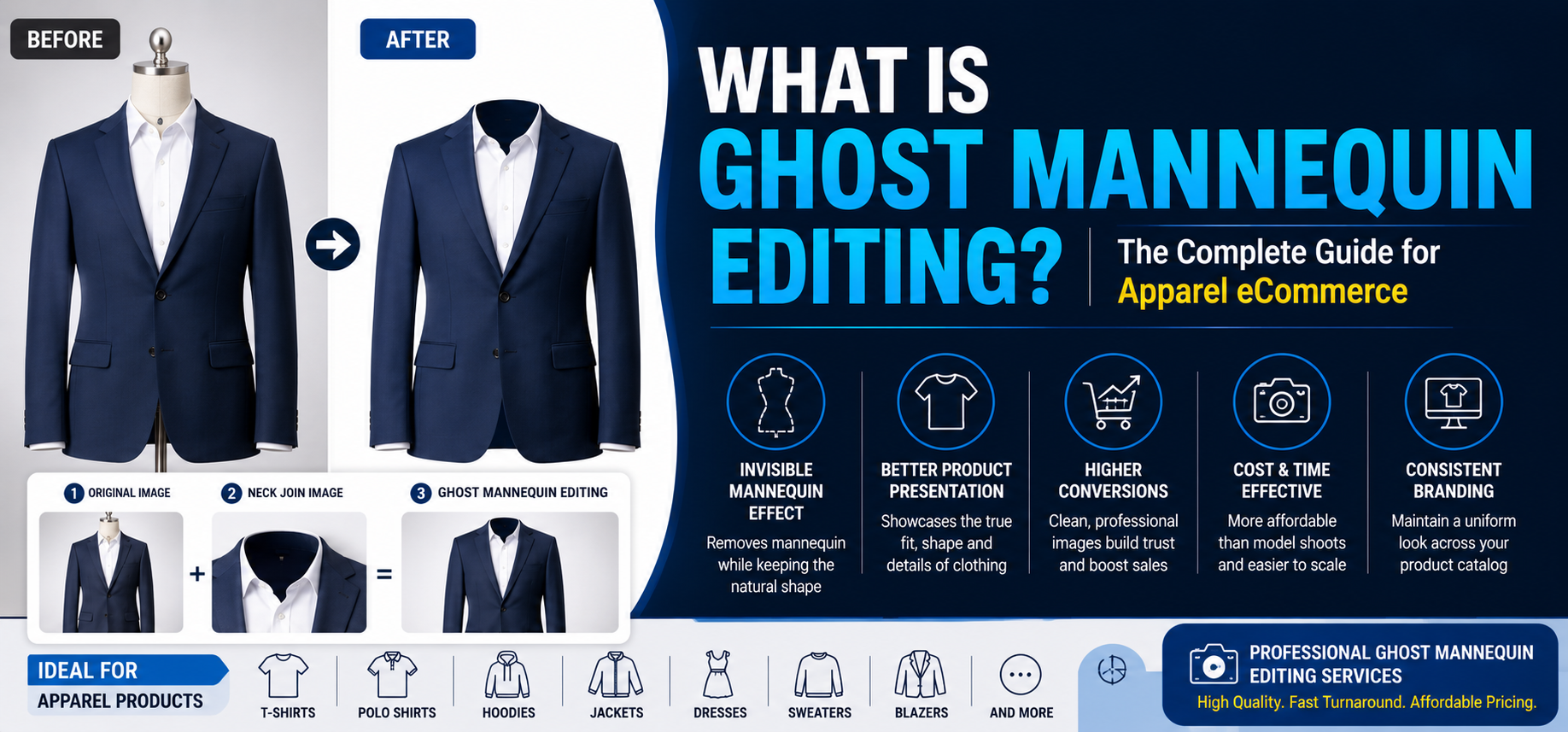
Ghost mannequin editing is a Photoshop technique that removes the mannequin, model, or dress form from clothing images while retaining the garment's three-dimensional shape.
The process combines multiple photographs—typically a front image and an inside-neck image—to create the illusion that the clothing is floating naturally.
The result is a clean, professional product image that highlights the garment itself without distracting elements.
You'll also hear this service referred to as:
- Invisible mannequin editing
- Neck joint service
- Hollow man effect
- 3D mannequin editing
Although the names vary, they all describe the same editing technique.
Why Fashion Brands Use Ghost Mannequin Editing
Online shoppers want to understand how clothing fits and hangs without being distracted by mannequins or models.
Ghost mannequin editing allows retailers to:
- Display the natural shape of garments
- Create a consistent look across product catalogs
- Focus attention on product details
- Maintain a premium brand image
Whether you're selling T-shirts, jackets, dresses, or sportswear, professional ghost mannequin editing helps your products look polished and ready for purchase.
How Ghost Mannequin Editing Works
Professional editors typically follow these steps:
Step 1: Photograph the Garment
The garment is photographed on a mannequin to preserve its natural structure.
Step 2: Capture the Inside Details
A second photo is taken to capture areas hidden by the mannequin, such as the inner collar or back neckline.
Step 3: Remove the Mannequin
Using Photoshop, the mannequin is carefully removed from the image.
Step 4: Join the Images
The inside details are seamlessly merged with the main photo to create a realistic, hollow effect.
Step 5: Apply Final Enhancements
Editors perform additional work such as:
- Color correction
- Dust and wrinkle removal
- Shape refinement
- Shadow creation
- Background cleanup
The final image is optimized for online stores and marketplaces.
Benefits of Ghost Mannequin Editing
1. Creates a Professional Product Presentation
Removing the mannequin keeps the customer's attention on the clothing rather than the display form.
2. Highlights Garment Fit and Structure
Ghost mannequin editing preserves the natural shape of the garment, helping shoppers better understand how it will look when worn.
3. Builds Brand Consistency
A consistent editing style across your product catalog strengthens your brand identity and creates a more polished shopping experience.
4. Increases Conversion Rates
Clear, high-quality product images help shoppers make confident purchasing decisions, often leading to higher conversion rates.
5. Reduces Photography Costs
Compared to model photography, ghost mannequin editing is often more affordable and easier to scale for large apparel catalogs.
Ghost Mannequin vs. Model Photography
| Feature | Ghost Mannequin | Model Photography |
|---|---|---|
| Focus | Garment | Lifestyle & Branding |
| Cost | Lower | Higher |
| Consistency | Excellent | Varies |
| Scalability | High | Moderate |
| Best For | Product Pages | Marketing Campaigns |
Many fashion brands use both methods: ghost mannequin images for product pages and model photography for advertising and social media.
Which Clothing Products Benefit Most?
Ghost mannequin editing works exceptionally well for:
- T-shirts
- Polo shirts
- Hoodies
- Jackets
- Dresses
- Sweaters
- Blazers
- Sportswear
- Children's clothing
- Uniforms
It is also widely used for luxury fashion collections and private-label brands.
Common Mistakes to Avoid
Poor Photography
Editing cannot fully compensate for poorly lit or poorly composed photos. Start with high-quality images whenever possible.
Incomplete Neck Joint Images
Failing to capture the inside collar or back neckline makes it difficult to create a convincing invisible mannequin effect.
Overediting
Excessive retouching can make garments appear unrealistic. The goal is to enhance the image while maintaining an accurate representation of the product.
Inconsistent Editing
Using different editing styles across your catalog can create an unprofessional appearance.
Ghost Mannequin Editing and Marketplace Requirements
Most major eCommerce platforms encourage clean, distraction-free product images.
Ghost mannequin editing helps apparel brands meet these expectations while maintaining a consistent and professional presentation.
Combined with a white background and accurate color correction, ghost mannequin images are ideal for:
- Amazon
- Shopify
- WooCommerce
- BigCommerce
- Magento
Why Outsource Ghost Mannequin Editing?
Many apparel businesses outsource this service because it offers:
- Faster turnaround times
- Access to experienced Photoshop editors
- Consistent quality
- Lower production costs
- Scalability for seasonal collections
Professional editing partners also ensure that every image meets marketplace standards and brand guidelines.
Choosing the Right Ghost Mannequin Editing Service
When selecting a service provider, look for:
- Manual Photoshop editing
- Experience with apparel photography
- Consistent quality control
- Fast turnaround
- Secure file handling
- Transparent pricing
Review before-and-after samples to evaluate the quality of their work before committing to large projects.
Conclusion
Ghost mannequin editing has become an essential part of professional apparel photography. By removing distractions and showcasing garments in a clean, three-dimensional format, it helps online retailers present products more effectively and create a better shopping experience.
For fashion brands targeting customers in the USA and Europe, investing in high-quality ghost mannequin editing can improve product presentation, strengthen brand consistency, and increase customer confidence.
Whether you're launching a new clothing line or managing thousands of SKUs, professional ghost mannequin editing is a smart investment that supports long-term eCommerce success.
Frequently Asked Questions
Is ghost mannequin editing better than flat lay photography?
It depends on your goals. Ghost mannequin editing better showcases the shape and fit of garments, while flat lay photography offers a more casual presentation.
Can ghost mannequin editing be used for all types of clothing?
Yes. It's suitable for most apparel, including shirts, dresses, jackets, sweaters, and sportswear.
Does ghost mannequin editing change the actual product?
No. It only removes the mannequin and enhances the presentation. The garment itself remains accurately represented.
What file format should I provide?
Most editing companies accept RAW, JPEG, TIFF, and PSD files.